

10 Sep The Cheetah in Bronze – Capturing Speed, Performance and the Spirit of the Wild
The Cheetah in Bronze – Capturing Speed, Performance and the Spirit of the Wild
Few animals create such an immediate impression of speed as the cheetah.
Its long legs, streamlined body and extraordinary running ability have made it one of the most recognisable animals in the world. Yet speed is only part of its appeal.
The cheetah also represents focus, agility, precision and the ability to act decisively when the moment arrives.
These qualities have fascinated wildlife enthusiasts for generations. They also explain why a cheetah can become such a powerful subject for sculpture.
A standing animal can be beautiful. Capturing one at full sprint is something altogether different.
Product Details
* Code: WI111
* Price: £7,195.00
* Size: 150 × 75 × 90 cm
* Weight: Approx. TBC
* Material: Genuine bronze
* Suitable for permanent outdoor display
* Video available
To view the product page for the Bronze Cheetah Sculpture click here.
Why Is the Cheetah Such a Powerful Symbol?
The cheetah is instantly associated with speed.
That single characteristic gives the animal symbolism far beyond the wildlife world. Speed can represent progress, ambition and competitive performance.
However, successful movement also requires control.
A cheetah cannot rely on power alone. Its athletic form creates an impression of balance, direction and intense concentration.
For this reason, the animal has natural associations with sport and achievement. Similar ideas can apply to entrepreneurship and business.
The symbolism is positive and forward-looking.
It is about pursuing something.
That makes the cheetah very different from wildlife subjects traditionally associated with dominance, defence or authority.
The Challenge of Capturing Movement in Bronze
Bronze is solid, permanent and immensely durable.
A sprinting cheetah represents almost the complete opposite. The animal is fast, fluid and constantly changing position.
Bringing those two qualities together creates an interesting artistic challenge.
The sculptor needs to convince the viewer that a completely stationary object is moving.
Body position becomes crucial.
In our Life-size Sprinting Cheetah Bronze Sculpture, the animal stretches dramatically forwards. Its extended body creates a strong horizontal line, while the legs reinforce the impression of rapid movement.
The long tail continues that movement behind the animal.
Viewed from the side, the composition can feel like a single moment frozen during a sprint.
Why the Tail Matters to the Sculpture
It is easy to focus on the head, body and legs when looking at an animal sculpture.
With a sprinting cheetah, the tail plays an equally important visual role.
In the bronze, it sweeps behind the body and extends the overall composition. This helps create a sense of direction.
Without that long trailing form, the sculpture would lose some of its momentum.
It also gives the eye a natural path to follow.
You see the cheetah driving forwards, then follow the body backwards towards the sweeping tail.
The result is a sculpture that appears longer, faster and more dynamic.
Wildlife Sculpture Does Not Have to Stand Still
Many traditional wildlife sculptures show an animal in a relatively static pose.
There are good reasons for this.
A standing stag can communicate majesty. A resting lion suggests confidence and strength. Meanwhile, an eagle with its wings extended can convey freedom and authority.
Movement changes the emotional response.
A sprinting cheetah creates anticipation.
The viewer instinctively imagines what happened immediately before the moment shown and what might happen next.
That sense of an unfinished story gives movement-based sculpture considerable energy.
It can also make the surrounding landscape feel more active.
Creating the Illusion of a Cheetah Crossing the Landscape
The position of a sculpture can completely change the way it is experienced.
A running animal does not necessarily need to face the viewer.
In fact, positioning a sprinting cheetah across the field of vision can strengthen the illusion of movement.
Imagine looking across a broad lawn and seeing the animal racing from one side to the other.
The full 150 cm profile becomes visible. More importantly, the surrounding open space gives the cheetah somewhere to appear to be running.
This principle can work beautifully beside a long driveway or within substantial grounds.
Space becomes part of the composition.
The sculpture provides the animal. The landscape provides the imagined movement.
Why a Pedestal Can Transform a Running Sculpture
There is another interesting way to change the appearance of a sprinting animal.
Raise it.
Placing a running cheetah on a substantial pedestal or plinth separates the body visually from the ground.
Suddenly, the sculpture can appear lighter.
The extended legs become easier to see, while clear space around the body emphasises its athletic shape.
A pedestal also changes the relationship between sculpture and viewer.
Instead of discovering an animal within a naturalistic landscape, the viewer is presented with a piece of wildlife art.
Neither approach is necessarily better.
One creates realism. The other celebrates the form of the sculpture itself.
From African Wildlife to Modern Business Symbolism
Perhaps one of the most interesting things about the cheetah is how easily its symbolism moves beyond wildlife.
Businesses frequently talk about speed, performance and agility.
The language is familiar because these qualities matter in competitive environments.
A company may need to respond quickly to changing markets. Entrepreneurs often pursue opportunities before competitors recognise them. Technology businesses may build their reputation around faster solutions.
The cheetah provides a natural visual metaphor for those ideas.
This can give cheetah sculpture an unexpected role within corporate environments.
Rather than choosing artwork simply because it fills a space, a business can select a subject that reflects something about its identity.
A Natural Connection With Sport and Performance
The same qualities translate easily into sport.
Speed is obvious. Yet performance involves far more than simply moving quickly.
Focus matters. So does preparation, timing and the determination to reach a target.
For athletes and sportspeople, those associations can make a cheetah particularly meaningful.
Motor racing provides another interesting connection.
There is something inherently appropriate about an animal renowned for acceleration being displayed in an environment devoted to performance and speed.
The symbolism does not need explaining with a plaque.
Most people understand it immediately.
Could Sculpture Reinforce a Company Identity?
Some businesses already use animals within their branding, logos or wider identity.
Turning that two-dimensional symbol into a physical sculpture can create an interesting opportunity.
Imagine arriving at a company headquarters and seeing its animal emblem represented in substantial bronze.
The sculpture becomes part of the experience of entering the business.
It can also provide continuity between branding and the physical environment.
Reception areas, landscaped headquarters and corporate entrances are all possibilities.
For businesses already associated with a cheetah or other fast-moving animal, the connection could be particularly strong.
The Emotional Connection With an African Safari
Of course, not everyone chooses wildlife sculpture because of symbolism.
Sometimes the reason is much more personal.
Seeing African wildlife in its natural environment can leave an extraordinary impression.
A safari may involve years of anticipation before the journey even begins. Once there, individual encounters can become memories that last for decades.
Spotting a cheetah is particularly memorable.
The animal has an elegance and physical presence that photographs cannot completely reproduce.
For someone who has experienced that moment, a bronze cheetah can represent far more than the species itself.
It can bring back a place, a journey and the people who shared it.
A Reminder of Africa for a Home Far Away
Wildlife can also create a connection with home.
For someone who grew up in South Africa or elsewhere on the African continent, familiar animals may carry memories of landscape and identity.
That emotional response can remain powerful even after moving thousands of miles away.
A piece of African wildlife art can therefore become surprisingly personal.
Placed within a British or European garden, a cheetah might provide a quiet reminder of another landscape entirely.
This is one reason wildlife sculpture can mean very different things to different owners.
One person sees speed.
Another sees ambition.
Someone else sees home.
Why Life-size Proportions Matter
Scale changes our relationship with animal sculpture.
A small bronze can beautifully capture the character of a species. However, life-size work creates a different experience.
The viewer begins to understand the physical dimensions of the animal.
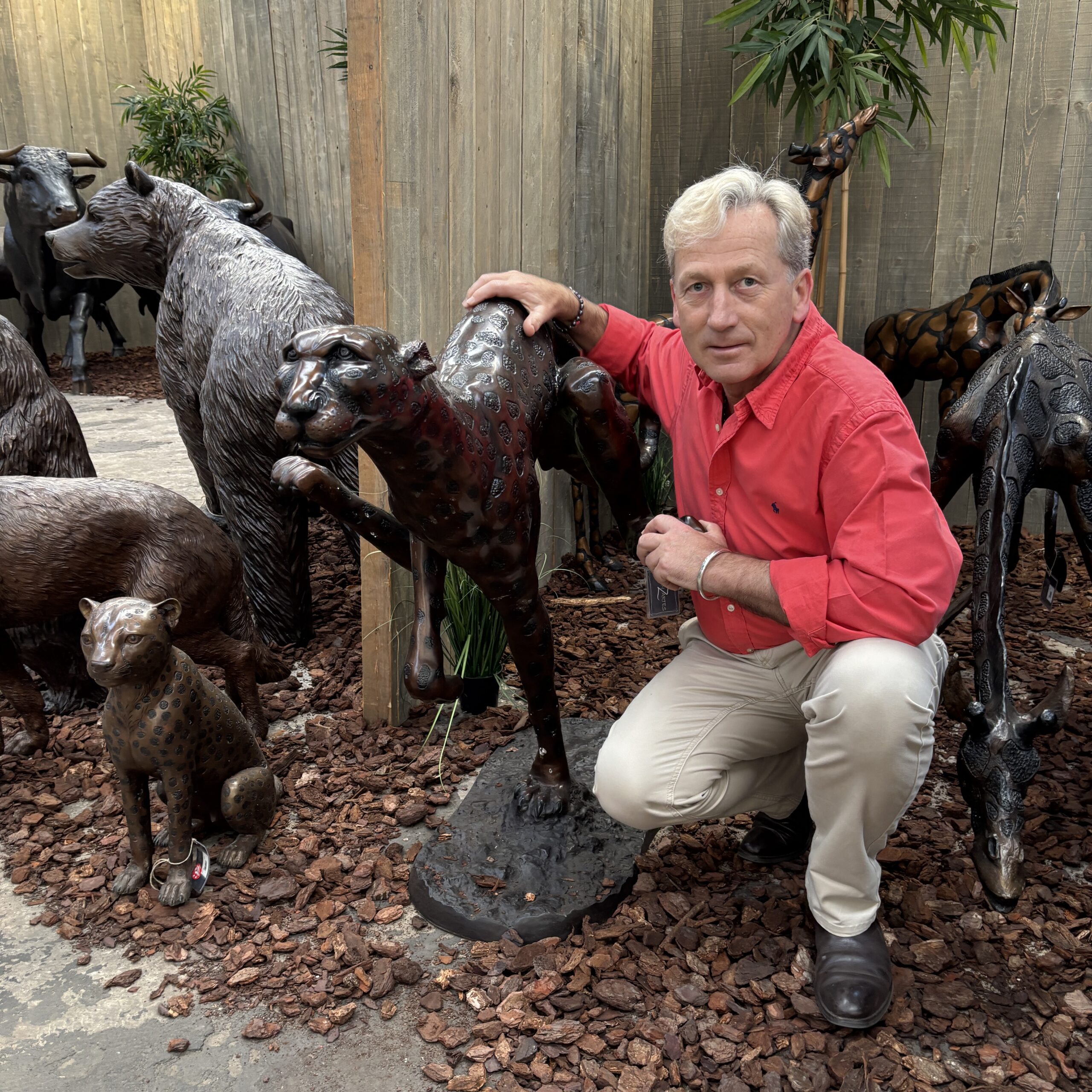
Our sprinting cheetah measures 150 cm long and 90 cm high. That gives the extended running form considerable presence.
Photographs showing a person beside the sculpture are particularly useful for this reason.
Suddenly, the measurements become understandable.
You can compare human proportions directly with the animal and begin to appreciate how much space the bronze occupies.
Why Video Is So Valuable for Sculpture
Photographs remain essential when viewing sculpture online.
However, sculpture is three-dimensional.
That creates a limitation.
One photograph can show the strongest angle, but it cannot fully communicate how the form changes as you move around it.
Video helps bridge that gap.
This becomes especially important with a sculpture based on movement.
As the camera travels around the sprinting cheetah, the relationship between its legs, extended body and long tail becomes clearer.
The viewer can also see how dramatically the sculpture changes from different directions.
For a substantial bronze being considered online, that additional perspective can provide valuable reassurance.
Lighting Wildlife Sculpture After Dark
Outdoor sculpture does not have to disappear when daylight fades.
Carefully positioned lighting can completely change its character.
A low light directed across a textured bronze creates highlights and shadows. On a sprinting cheetah, this could emphasise the long body, muscular form and spotted surface.
The shadow itself may become part of the effect.
Pedestal-mounted sculpture offers further possibilities because light can pass around and beneath the animal.
For hotels, entrances and commercial landscapes, evening illumination extends the visual impact well beyond normal daylight hours.
Private gardens can benefit too, especially when the sculpture is visible from the house or terrace.
Building a Collection of African Wildlife Sculpture
One major bronze can transform a landscape.
Several can begin to tell a story.
A collection of African wildlife does not necessarily need to be arranged together like an exhibition.
In substantial grounds, separating the sculptures can be far more interesting.
A cheetah might cross an open lawn. Giraffes could appear beyond planting, while another animal waits near water or woodland.
Visitors then discover each sculpture as they move around the property.
This turns the landscape itself into part of the collection.
For owners with enough space, the result can feel more natural and considerably more engaging than grouping every animal in one location.
Why Bronze Works So Well for Wildlife
Wildlife sculpture needs texture.
Fur, musculature and changing contours all respond beautifully to light.
Bronze handles these details particularly well.
It also has the durability required for permanent outdoor display.
Genuine bronze does not rust or corrode. Consequently, a sculpture can remain outdoors throughout the seasons rather than being moved inside every winter.
This becomes especially valuable with larger pieces.
A substantial bronze may form part of a carefully planned landscape or permanent pedestal installation.
Over time, planting can grow and the surroundings can change while the sculpture remains.
Choosing Wildlife Art With Personal Meaning
The strongest sculpture purchases are often about more than appearance.
A subject can represent a memory, achievement, passion or ambition.
That is particularly true of animals.
Someone may choose an owl because of its association with wisdom. An eagle can represent freedom or achievement. A stag might suit a country estate because of its natural relationship with the surrounding landscape.
The cheetah offers something different.
It represents movement.
For some people, that means sporting performance. For others, it suggests business ambition, determination or the pursuit of a goal.
Wildlife enthusiasts may simply admire one of nature’s most extraordinary animals.
There is no single correct interpretation.
That is precisely what makes the subject interesting.
Capturing a Fraction of a Second Forever
Perhaps the greatest contradiction within a sprinting cheetah sculpture is also what makes it so compelling.
A cheetah at speed represents a fleeting moment.
Bronze represents permanence.
Bring the two together and a fraction of a second can effectively be held forever.
The animal remains stretched in pursuit, its body driving forwards and its tail sweeping behind.
Nothing actually moves.
Yet everything about the sculpture suggests movement.
For wildlife collectors, safari enthusiasts, sportspeople and entrepreneurs, that can create a remarkably powerful piece of art.
The cheetah may be famous for being fast.
In bronze, however, its greatest achievement may be making speed stand still.

Sorry, the comment form is closed at this time.