


16 Sep The Silent Watcher – Why a Bronze Owl Sculpture Creates Such an Atmospheric Garden Feature
The Silent Watcher – Why a Bronze Owl Sculpture Creates Such an Atmospheric Garden Feature
There is something particularly captivating about discovering an owl in a garden.
Unlike a sculpture positioned simply to dominate a lawn or fill an empty space, an owl can create a completely different reaction. Perched quietly above the landscape, it feels watchful, secretive and almost alive.
That sense of mystery is one reason owl sculptures work so beautifully outdoors.
Among mature trees, woodland planting and quieter corners of a large garden, a bronze owl can become something visitors gradually discover rather than immediately see.
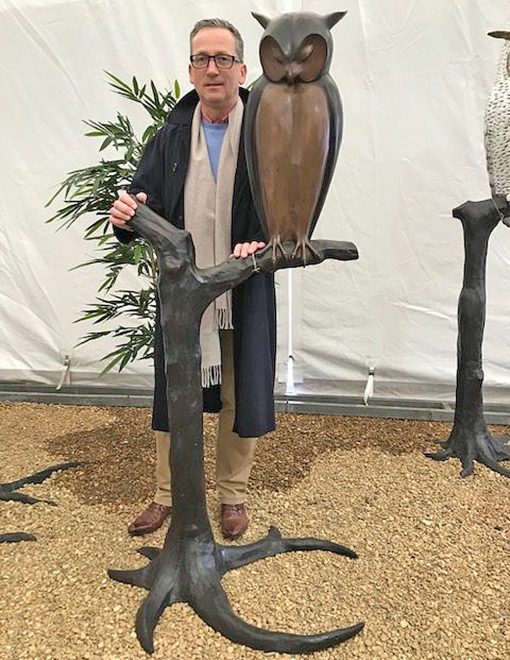
Our Bronze Bird Sculpture Long Eared Owl On Tree takes this idea considerably further.
Standing an impressive 171 cm high, the owl sits above a sculpted tree form. Its long-eared silhouette, unusual finish and commanding height create an exceptionally atmospheric piece of wildlife sculpture.
Featured Bronze Sculpture
* Sculpture: Bronze Bird Sculpture Long Eared Owl On Tree
* Code: BI57
* Price: £3,595.00
* Size: 171 × 65 × 96 cm
* Weight: Approx. 26 kg
* Material: Solid bronze
* Suitable for permanent outdoor display
To view the product page for the Bronze Long Eared Owl Sculpture click here.
Why Are Owls So Effective as Garden Sculpture?
Some animals naturally suit sculpture because their character remains powerful even when completely still.
An owl is a perfect example.
Its impact does not depend upon movement. In fact, stillness is part of its appeal.
An owl can sit silently on a branch while appearing completely aware of everything happening around it. Recreating that watchful posture in bronze gives the sculpture an immediate sense of life.
There is also something intriguing about where an owl belongs.
We naturally associate these birds with trees, woodland, dusk and the quieter hours of the day. Therefore, when an owl sculpture appears among mature planting, the surrounding landscape becomes part of the composition.
The garden is no longer simply a backdrop.
It helps tell the story.
The Importance of Height in Wildlife Sculpture
Height can dramatically change the way we experience a sculpture.
Most garden animals are naturally viewed at or below eye level. An owl is different.
We expect to look upwards.
Placing the bird high above the ground creates a much more convincing relationship between the sculpture and the viewer. Rather than looking down at an ornamental owl, you find yourself looking towards a bird apparently surveying its territory.
That difference is important with BI57.
At 171 cm high, the overall sculpture is close to the height of many adults. However, because the owl itself occupies the elevated part of the composition, the eye is naturally drawn upwards.
From farther across the garden, this creates a strong vertical silhouette.
Closer inspection then reveals the tree form, feather detailing, expressive face and distinctive ear tufts.
A Sculpture That Rewards Discovery
Not every important garden sculpture needs to stand in the middle of a lawn.
Sometimes the most memorable pieces are partially concealed.
Imagine following a pathway through an established garden before suddenly noticing an owl watching from beneath the trees.
Alternatively, picture the sculpture standing beyond a large border. Initially, only the upper part of the bird may be visible through the planting.
That gradual discovery can be far more interesting than revealing everything immediately.
It also gives garden owners considerable freedom when positioning wildlife sculpture.
A carefully chosen location can encourage visitors to explore. The sculpture becomes a destination within the garden rather than simply decoration surrounding the house.
Creating a Woodland Focal Point
For properties fortunate enough to have mature trees, an owl is an obvious subject to consider.
However, positioning remains important.
Placing a tall bronze directly against dense vegetation may reduce its silhouette. Instead, allowing some breathing space around the sculpture can help the shape remain clearly visible.
A woodland edge can therefore be particularly effective.
Here, darker trees provide a natural backdrop while open lawn or lighter planting in front allows the bronze to stand out.
Another possibility is a clearing.
A sculpture discovered within a small opening between trees can create a wonderfully private focal point. Add a bench nearby and the location becomes somewhere to stop rather than simply pass through.
For larger gardens, this approach can help create different areas of interest throughout the grounds.
Why Bronze Works So Naturally Outdoors
Bronze and the natural landscape have enjoyed a remarkably successful relationship for generations.
Part of the appeal comes from colour.
Bronze tones sit comfortably beside bark, stone, foliage and earth. Consequently, wildlife sculpture can become integrated into a garden without losing its individual presence.
There is also the permanence of the material.
Solid bronze does not rust, corrode or decay. A substantial bronze sculpture can therefore remain outside permanently throughout the changing British seasons.
That makes it especially appropriate for woodland settings.
Leaves may fall around it in autumn. Frost can transform the landscape during winter. Spring growth gradually surrounds it again, followed by the deeper greens of summer.
The sculpture remains.
Over time, that continuity can make a well-positioned bronze feel increasingly established within its surroundings.
Garden Sculpture Changes With the Seasons
One of the great pleasures of outdoor sculpture is that it never looks exactly the same throughout the year.
A sculpture displayed indoors is largely controlled by its immediate environment. Outdoors, nature continually changes the presentation.
An owl beneath summer foliage may feel secluded and secretive.
During autumn, bronze tones can sit beautifully among fallen leaves and warmer seasonal colours.
Winter creates something entirely different. Bare branches reveal more of the sculpture, while frost and low sunlight can emphasise its silhouette.
Then spring gradually introduces fresh planting around the base.
For a sculpture inspired by wildlife, these seasonal changes seem particularly appropriate.
The artwork becomes part of the evolving garden.
Consider the View From Inside the House
Garden sculpture is often positioned while standing outside.
However, one of the most important viewpoints may actually be from indoors.
Before deciding on a permanent location, look through the principal windows of the property.
Could the owl be positioned where it becomes visible from a sitting room, kitchen, hallway or conservatory?
A tall sculpture can work particularly well for this purpose because planting is less likely to completely obscure it.
From inside the house, an owl among distant trees can create a fascinating view.
During poor weather or throughout winter, that relationship becomes even more valuable. The sculpture continues to provide a focal point even when the garden itself is being enjoyed through glass.
Using Distance to Create Atmosphere
Large gardens present an interesting challenge.
A sculpture that looks substantial from two metres away can almost disappear when positioned 30 or 40 metres from the house.
Scale therefore needs to be considered alongside viewing distance.
The 171 cm overall height of our long-eared owl gives it an advantage in larger landscapes. Its narrow vertical form remains distinctive without occupying the enormous footprint required by some monumental sculptures.
This creates interesting possibilities.
At the end of a lawn, the owl can draw the eye towards the landscape beyond.
Beside a distant pathway, it can encourage exploration.
Among trees, meanwhile, the height allows the upper silhouette to remain visible above lower planting.
The result can be dramatic without feeling overpowering.
Transforming an Owl Sculpture After Sunset
Outdoor sculpture does not need to disappear when daylight ends.
Carefully planned garden lighting can completely alter its personality.
Owls are particularly suited to this treatment because we already associate them with dusk and darkness.
A discreet uplight positioned near the base of a tall sculpture can pick out the tree form before illuminating the bird above. Shadows created by branches and surrounding foliage can add another layer of atmosphere.
Importantly, the aim does not need to be maximum brightness.
Subtle lighting is often far more effective.
From the house or terrace, just enough illumination to reveal the owl’s silhouette may create a stronger effect than flooding the entire area with light.
During an evening gathering, the sudden discovery of a large owl watching from the edge of the garden could become a memorable feature.
Wildlife Art for Contemporary Gardens
Wildlife sculpture is sometimes associated primarily with traditional country gardens.
It need not be.
A strongly shaped bronze can provide an excellent contrast within contemporary landscaping.
Simple architectural planting, clipped forms, ornamental grasses and modern paving can all provide an effective setting for wildlife art.
The contrast is part of the appeal.
Natural subject matter introduces warmth and character, while the structured landscape prevents the sculpture from feeling overly traditional.
BI57 has particular potential here because its elongated proportions and unusual character already give it a slightly contemporary appearance.
Against a simple wall, dark planting or modern architecture, the distinctive silhouette could become especially striking.
To see and appreciate this stunning owl sculpture through video
Owls, Wisdom and Symbolism
Owls have accumulated a remarkable range of associations throughout human history.
Perhaps the most familiar is wisdom.
They are also frequently connected with observation, knowledge, independence and mystery.
For someone choosing a sculpture as a significant gift, those associations can add another dimension to the purchase.
A large bronze owl could mark a retirement, important birthday, professional achievement or other major occasion.
The recipient may simply love owls. However, the symbolism can make the gift feel considerably more personal.
Unlike

Sorry, the comment form is closed at this time.